
Restorative/Crown
Alternatives
We will inform you of the apparent best type of
restoration for your posterior teeth, and we will discuss your situation
relative to the nature of the restorations.
This information is provided to assist you
in making choices about restorations for your posterior teeth
(bicuspids and molars).
- Gold Alloys have
been used for many decades for the highly successful restoration
of posterior teeth. They are nontoxic, wear very similarly
to tooth enamel when opposed by natural teeth, and are
soft enough that years of use allow them to "wear in" much
like natural teeth. Well-placed cast gold restorations
usually have longevity of several decades in patients without
peculiar tooth grinding habits (bruxism or clenching).
In mouths with severe wear patterns, gold is the material
of choice because gold is strong yet soft.
However, gold
is not tooth colored, and in many situations, it cannot
be used because it creates unsightly display of metal.
You will be advised if gold could be used in your mouth
without significant display. WHEN ESTHETICALLY POSSIBLE,
CAST GOLD IS THE LONGEST LASTING, STRONGEST TYPE OF POSTERIOR
TOOTH RESTORATION.
- Porcelain-Fused-To Metal Restorations have
been in service for over 30 years. They are a metal coping
(thimble), with tooth-colored porcelain baked onto it.
Such restorations can be as beautiful as natural teeth
when placed in the mouth. These restorations are strong
and very lifelike, but they have some negative characteristics.
These
usually are not acceptable for patients with tooth grinding
habits because they may crack or break under enormous stress.
Second, they wear down opposing natural teeth in patients
with grinding habits. Third, extreme stress (e.g., ice
chewing, bones, or cherry pits) can break the porcelain
from the metal.
However, in most patients, PORCELAIN-FUSED-TO
METAL RESTORATIONS PROVIDE EXCELLENT, BEAUTIFUL, LONG LASTING
POSTERIOR TOOTH RESTORATIONS.
- CERAMIC RESTORATIONS are
now available. They do not have any cast metal in them.
These are fired cast porcelain, or other ceramics. They
are suggested only for single crowns and not for multiple
units connected together. Their strength is not as high
as porcelain-fused-to metal restorations. THESE RESTORATIONS
ARE HIGHLY ESTHETIC AND ARE MOST INDICATED FOR PEOPLE WITH
METAL ALLERGIES.
[ Back to top ]
Whitening
Whitening
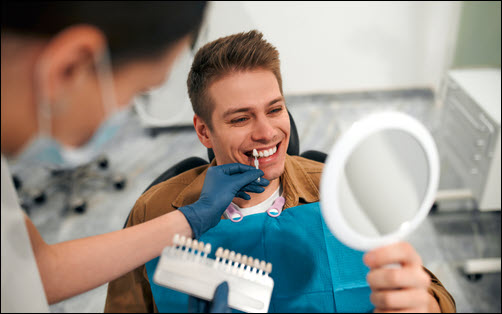
takes from 30 minutes to one hour per visit. It is virtually pain free
and requires no anesthetic. To protect the mouth, a gel-like substance
is applied to the gums and a rubber "shield" is placed
around the necks of the teeth. A chemical solution is then 'painted'
on the teeth. A special light, focused on the teeth for 20 to 30 minutes
(at five minute intervals) helps activate the solution.
Advantages of Whitening
The advantages of tooth whitening over other procedures
that whiten teeth are that it doesn't require any tooth structure
be removed and it is the most economical. Even teeth that have
had root canals can easily be whitened. Whitening, which has
been practiced for more than 15 years, has virtually no side effects.
Results
To get the best results, whiten your teeth a shade lighter
than you desire, since they will tend to darken slightly with time. Anywhere
from 2 to 10 visits may be required to complete the process.
You should avoid stain-causing beverages such as coffee
and tea for several days after the procedure, because your teeth
may more readily absorb stain at that time. Daily brushing and
flossing and regular professional cleanings--along with occasional
touchups keep your teeth white so that you can again feel confident
in exercising your smile.
[ Back to top ]
Crown & Bridge
Cracked
Tooth Syndrome - You may have a very commonly occurring problem
in one of your teeth. Teeth may crack when subjected to stress
of chewing hard foods or ice, or by biting on an unexpected hard
object. Teeth with or without restorations may exhibit this problem,
but teeth restored with typical silver alloy restorations are
most susceptible.
Symptoms And Signs:
- Pain when chewing
- Pain on cold air application
- Unsolicited pain (usually leakage of sugar into tooth
crack)
- No radiograph evidence of problem
- No dental decay present
- Easy verification of crack when tooth is prepared for
restoration
Treatment of Cracked Teeth
- Simple Crack : The majority of cracked teeth
(about 9 out of 10) can be treated by the replacement of
a simple crown (cap) on the tooth. When the tooth is prepared
for the crown, and a temporary restoration is placed, the
pain usually leaves immediately. IF THIS IS THE CASE WITH
YOUR TOOTH, WE WILL PLACE THE FINAL CROWN WITHOUT A PROBLEM
ON YOUR NEXT APPOINTMENT AND THE CONDITION SHOULD BE SOLVED.
- Complex Crack : Occasionally (about 1 in 10)
the tooth cracks into the pulp (nerve) of the tooth. IF PAIN
PERSISTS AFTER PLACEMENT OF THE TEMPORARY CROWN, YOU MAY
HAVE A CRACK INTO THE PULP OF THE AFFECTED TOOTH. PLEASE
CALL US. THIS TOOTH MAY REQUIRE ENDODONTIC TREATMENT (ROOT
CANAL THERAPY) BEFORE THE CROWN IS PLACED. This requires
about two additional appointments before the crown is placed.
[ Back to top ]
Endodontics & Root Canal Therapy
Natural teeth are meant to last a lifetime.
Even if one of your teeth should become critically injured
or diseased, it can oftentimes be saved through a specialized
dental procedure known as endodontic treatment (root canal
therapy). To help you understand when and why such a procedure
might be needed and how a damaged tooth can be saved, we
have answered some of the most frequently asked questions
about endodontic treatment.
What is Endodontics?
Endodontics is the area of dentistry concerned with the
prevention, diagnosis and treatment of disorders of the
dental pulp (the tooth's soft core). Years ago, teeth with
diseased or injured pulp were extracted. Today, endodontic
treatment gives dentists a safe and effective means of
saving teeth.
What is Dental Pulp?
The pulp is a soft tissue that contains the
nerves, arteries, veins and lymph vessels of a tooth. It
lies within the dentin, the bone-like tissue that supports
the enamel. Within the dentin, the pulp extends from the
pulp chamber in the crown (the portion of the tooth that
is visible above the gums) down to the tip of the root by
way of the root canal. All teeth have only one pulp chamber,
but teeth with more than one root will have more than one
canal.
What happens to the damaged pulp?
When the pulp is diseased or injured and unable
to repair itself, the pulp dies. The most common cause of
pulp death is a tooth fracture or a deep cavity that exposes
the pulp to saliva. The bacteria found in saliva causes infection
inside the tooth. Left untreated, the infection eventually
causes the pulp to die. Pus can build up at the root tip,
forming an abscess that can destroy the supporting bone
that surrounds the tooth.
Why does the pulp need to be removed?
If the damaged or diseased pulp is not removed, the tooth
and surrounding tissues become infected. Pain and swelling
may accompany the infection. Even in the absence of pain,
certain byproducts of a diseased pulp can injure the bone
that anchors your tooth in the jaw. Without endodontic
treatment, your tooth will eventually have to be removed.
What does Endodontic treatment involve?
Treatment usually requires from one to three appointments.
During these treatments, the diseased pulp is removed.
The pulp chamber and root canal(s) of the tooth are then
cleaned, shaped, filled and sealed to prevent recontamination
of the root canal system. Root canal therapy usually is
a relatively painless procedure. In the final step, a gold
or porcelain crown is usually placed over the tooth to
restore structure, function and appearance.
*This information was provided by the American Dental
Association
[ Back to top ]
Orthodontics

For more information about what kinds of orthodontic treatments
are available at Tully Dental, please call our office to schedule
an appointment with Dr. Tully for a consultation.
[ Back to top ]
Limited Surgery
For more information about the limited surgery available at Tully Dental,
please call our office to schedule an appointment for a consultation with
Dr. Tully.
[ Back to top ]
Periodontics
Periodontal disease
is a bacterial infection of the gums and bone caused by dental
plaque, the soft, sticky substance that forms on the teeth. It
is estimated to effect 4 out of every 5 people. If the plaque
is allowed to remain and grow on the teeth, an inflammation of
the gums called Gingivitis occurs.
As the disease progresses the pockets of bacteria deepen, destroying
the bone which holds the teeth in the mouth. This results in teeth
loss. Periodontal
disease progresses silently, often without pain or overt symptoms
that would alert you to its presence. It may develop slowly or progress
very rapidly. With this in mind, please be aware of the following
signs and symptoms:
Visible Signs
- Gums that bleed when you brush your teeth.
- Gums that are red, swollen, or tender.
- Gums that have pulled away from you teeth.
- Permanent teeth that are loose or separating.
- Changes in the way your teeth fit together when biting.
- Any changes in the fit of partial dentures.
- Pus between your teeth and gums.
- Chronic bad breath or bad taste.
Invisible Signs
- Abnormal spaces (periodontal pockets) developing between
the teeth and gums.
- Loss of the jawbone that normally surrounds and supports
the teeth.
[ Back to top ]
Removable Full & Partial Dentures
Removable partial dentures can be a great help
to people who have lost some of their natural teeth. Some
partial dentures are attached to the adjoining teeth by metal
clasps. Others are fitted into adjoining teeth with precision
attachments. We will help you select the type that is best
for you.
IF YOU HAVE A REMOVABLE PARTIAL DENTURE, OR
ARE ABOUT TO GET ONE, YOU'VE TAKEN A NECESSARY AND IMPORTANT
STEP TOWARD MAINTAINING YOUR ORAL HEALTH.
Here's why:
- Wearing a partial denture can help your
remaining teeth stay in position. When there are spaces
between natural teeth, the teeth may drift or tip, placing
unnatural stress on the tissues of the mouth. Teeth that
are tipped or out of position are often hard to clean and
are therefore at greater risk of tooth decay and periodontal
diseases, which can cause additional tooth loss.
- Chewing is easier and more comfortable
if missing teeth are replaced. If teeth are missing,
you may chew food on only one side of your mouth, placing
too much stress on that side. This can eventually lead
to further problems with the gums and other tissues of
the mouth.
- Wearing a partial denture can also benefit
your speech and appearance. You need your teeth to
make many sounds properly. They also help maintain the
natural shape of your face by supporting your lips and
cheeks.
Adjusting Partial Dentures
Your partial denture was made to fit precisely,
but your mouth is constantly changing. In time, your gums
and the bone supporting your partial denture may shrink,
causing it to become loose or rock. If your appliance becomes
loose, contact us as soon as possible. Only a dentist can
determine how your mouth has changed and what should be done
to refit your partial dentures.
Repairing Partial Dentures
If your partial denture breaks, cracks or chips,
or if a denture tooth becomes loose, contact us immediately.
Do not try to mend it yourself. Using a do-it-yourself repair
kit can damage the denture and make it impossible to repair.
Over-the-counter glues often contain chemicals that can damage
the plastic denture material and harm oral tissues. However,
we can usually repair a broken denture, often on the same
day.
It is especially important to contact us if
your partial denture breaks while you are eating. This sometimes
indicates that there has been a change in the fit of the
dentures because the underlying tissue has changed. When
we repair your denture, we will also examine your mouth and
check whether your partial denture needs adjustment.
Regular Dental Visits
Even if your partial denture is undamaged and
feels comfortable, you should see us at least once a year
to protect your oral health. During these visits, you will
receive a complete oral examination. We will check for signs
of oral cancer and examine your gum ridges, tongue and the
joints of your jaw. If you suffer from dry mouth (xerostomia)
an artificial saliva may be prescribed. We will also look
for signs of general diseases, including diabetes, that can
show up in the mouth. When necessary, your natural teeth
will be cleaned and your partial denture will be refitted.
Most people can wear a removable partial denture
successfully-it just takes a bit of time to become adjusted.
And with a little effort spent on regular oral hygiene, all
remaining natural teeth can last a lifetime.
Cleaning The Dentures And Your Mouth
Your dentures can be cleaned easily with a
denture brush and a mild toothpaste or mild hand soap. Use
special care to clean any part of the partial that comes
in contact with any natural teeth. Both the partial denture
and the natural teeth must be kept very clean on a daily
basis to reduce the chance of new dental decay starting.
Use toothpaste containing fluoride. Denture soaks are also
useful for the denture. Brush your gums twice a day with
regular toothbrush to toughen and clean them. Leave the dentures
out of your mouth at night. While they are out leave them
soaking in water.
*This information was provided by the American
Dental Association.
[ Back to top ]
Implants
Originated in Sweden in the 1960's, this
type of system has now had over 30 years of successful
use. Upper or lower implants can replace single teeth or
an entire arch of teeth and have shown approximately 90%
success over 30 years. Lower implants have been more successful
than uppers and are currently the most widely used implants.
Dental Implants Solve Problems
Associated With Removable Dentures.
While conventional
dentistry enables some people to wear dentures comfortably,
research has shown 85% of the estimated 32 million people
with dentures experience some discomfort and difficulty
due to their false teeth. Dental implants eliminate the
discomfort and embarrassment often associated with dentures.
Where some teeth are missing, dental implants may be
used to eliminate the need for a removable partial denture
by providing the support necessary for attachment of
a fixed bridge. Patients with implants have reported
their confidence has been restored and their quality
of life improved. Dental implants help prevent the premature
loss of remaining teeth and are a good investment in
oral health.
What are implants?
Implants,
made from biocompatible materials, can become directly
attached to the jaw bone. In dental terms this is called "osseointegration".
The implant then performs a function similar to a healthy
natural tooth.
What procedures are used to insert implants?
The insertion of implants is a surgical procedure
performed in a single office visit. The implant is designed
to be submerged under the gum tissue, allowing time for
the implant to attach directly to the bone. After a healing
period of three to six months, a brief second procedure
is needed to expose the top of the implant. An appropriate
post is then attached to the implant to support a bridge
or denture.
What restorations are possible with implants?
- REPLACE A SINGLE TOOTH. One implant with a crown can
replace a single missing tooth, eliminating the need
to prepare adjacent natural teeth.
- ELIMINATE A PARTIAL DENTURE. Implants can be used as
a support for a fixed bridge by either connecting to
natural teeth or to other implants.
- STABILIZE A DENTURE. A removable denture can be retained
by several implants while still being supported by tissue.
- RETAIN AND SUPPORT A DENTURE. A removable denture can
be retained and supported by four to six implants joined
by a bar.
- SUPPORT A COMPLETE BRIDGE. Jaws missing all the teeth
can be restored with fixed bridges anchored by five or
six implants. This restoration is removable only by your
dentist.
Am I a candidate for implants?
Generally, anyone who is healthy enough to
have a routine extraction can be considered for dental implants.
The main limitation is the amount of available bone which
can usually be determined by a clinical and radiographic
examination.
What inconvenience will I experience?
Most patients report only minor discomfort
similar to that associated with simple tooth extraction.
When the patient wears a partial or full denture prior to
the surgery, the denture can often be modified with a soft
lining. This surgery provides little disruption of normal
business or social activities.
How long will my implants last?
Research has indicated that implants offer
long-term predictability once osseointegration has taken
place. Studies have shown that implants achieve osseointegration
on a highly consistent basis. The success of implants depends
on a number of variables including individual patient health,
oral hygiene, anatomical variations and restoration design.
[ Back to top ]
Preventative
Tooth decay often occurs in the chewing surface of back teeth.
To prevent the chance of cavities forming in these areas sealants are
applied.
What is a sealant?
A sealant is a clear shaded plastic material that is applied
to the chewing surfaces of the back teeth (premolars and molars),
where tooth decay occurs most often. Sealants act as a barrier,
protecting the decay-prone areas of the teeth from plaque and
acid.
Fact: Even a single tooth brush bristle is too large to
reach inside the pits and fissures of the molars.
How are sealants applied?
Each tooth takes only a few minutes to seal. First, the teeth
that will be sealed are cleaned. The chewing surfaces are then
etched (roughened) with a weak acidic solution to help the sealant
adhere to the tooth surface. Finally the sealant is brushed on
and and allowed to harden. Some sealants need a special curing
light to help them harden; others do not.
[ Back to top ]
Diagnostic X-Rays
Types of X-rays
- A bitewing X-ray picture shows
the upper and lower teeth on one film. It is especially helpful in revealing
decay between the teeth, and bone loss in early stages of periodontal
(gum) disease.
- A periapical X-ray picture
shows the entire tooth, including the tip (apex) of the root
and some of the surrounding tissues.
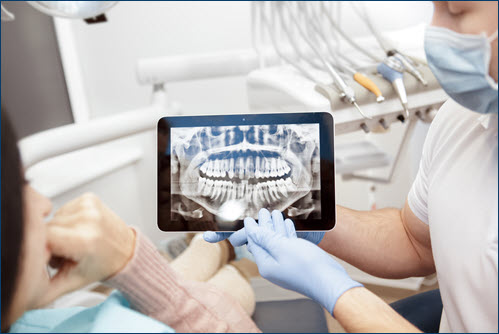
- A Panoramic X-ray picture shows
all the upper and lower teeth, jaws and other structures. It
is frequently used to the extent of growth, tooth eruption,
and orthodontic problems. Panoramic radiographs can also be used for
diagnosis of jaw fractures or before a denture is considered. Unerupted
teeth, retained root tips, and other conditions of the jaw can all be
seen.
- Digital x-rays are a computer generated image of the teeth and boney
structures. Digital x-rays offer the benefit of using 70-80% less
radiation using a digital sensor versus traditional plastic x-ray films. The
computer image permits immediate viewing and can be enlarged and modified
to enhance patient education and quick diagnosis.
[ Back to top ]
|